
Applied Physical Inorganic Chemistry
– Spectroscopy from a Chemist’s Point of View –
by
Karsten Meyer | Friedrich-Alexander-Universität Erlangen-Nürnberg (FAU)
Abstract. The course “Applied Physical Inorganic Chemistry – Spectroscopy from a Chemist’s Point of View” presents the basics of Electron Paramagnetic (Spin) Resonance (EPR or ESR) and Mössbauer spectroscopy and gives an introduction to molecular magnetism. 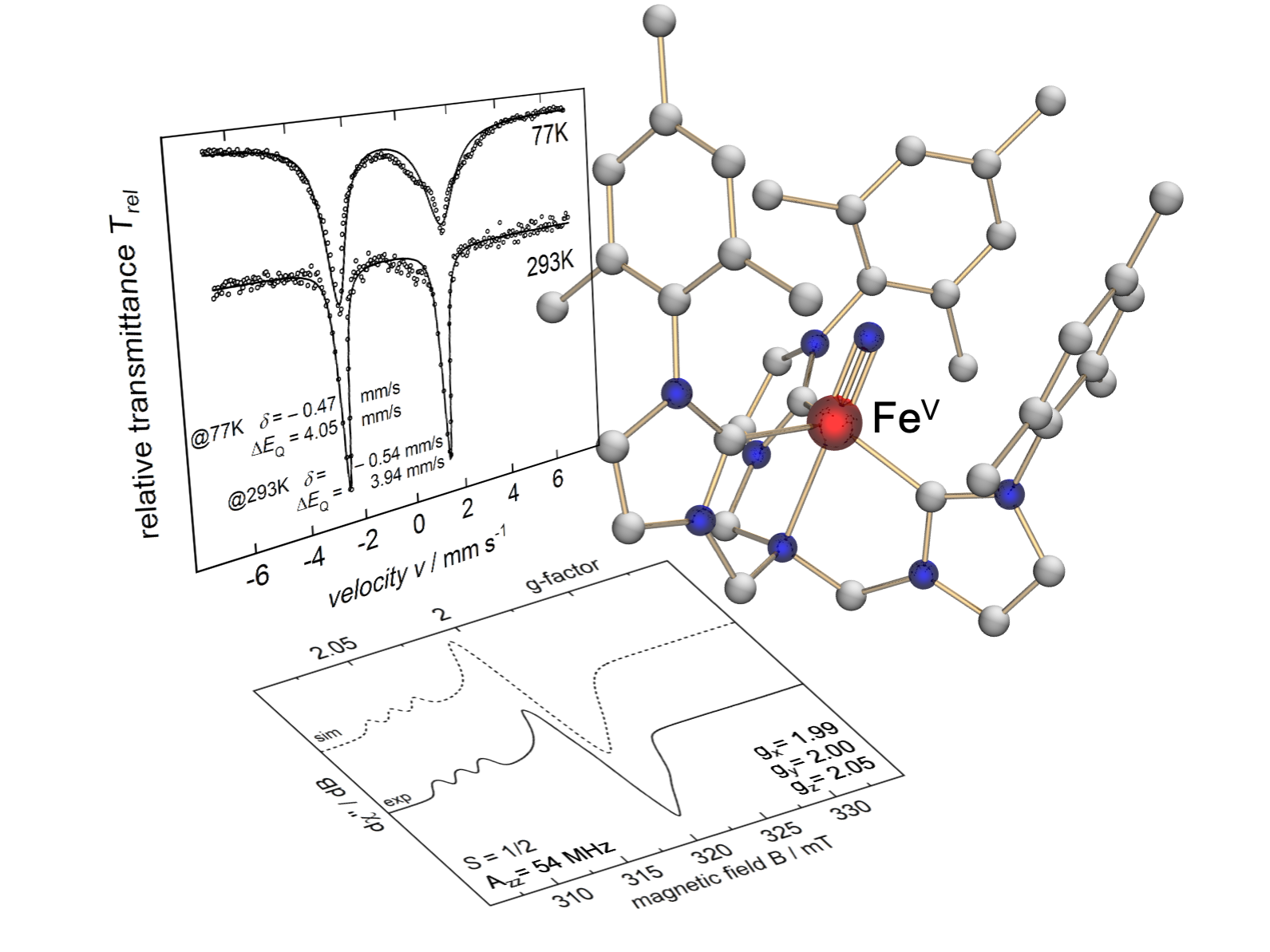
The intention of this course originates from the (my) recognition that there is more to the application of physical methods (spectroscopic techniques) in chemistry than the physics behind the machine and theory. Thus, chemists without an advanced mathematical background can appreciate spectroscopic methods by learning how to read a spectrum to extract the information required to elucidate a compounds’ molecular and electronic structure (and hence, its origin of reactivity).
This class is aimed at an audience of advanced undergraduate (bachelor) and graduate (master) students as well as postdoctoral fellows with an interest in molecular inorganic and organometallic chemistry. A significant part of the presented material involves (transition) metal coordination complexes with unpaired d-electrons. Thus, basic knowledge about the d-orbitals and their splitting in the most common tetrahedral or octahedral ligand fields is beneficial, and a basic understanding of spectroscopy, of how electromagnetic radiation interacts with “a molecule”, is valuable. Some experience with simple laboratory techniques, such as UV/vis electronic absorption and/or NMR spectroscopy would be a plus as well.
The lecture material relies heavily on examples that illustrate the kinds of information that can be obtained by application of the method. I consider most of the presented examples “textbook examples” taken from molecules studied by my own research group, or in collaboration with friends and colleagues.
Examples will be taken from the current literature
Leading Reference
“Physical Methods for Chemists”
2nd Edition
Russel S. Drago, Surfside Scientific Publishers, Gainesville, FL, 1992